Lash mapping for hooded eyes, lift first.
Updated 15 October 2026
A hooded eye swallows length. You can put a 12 mm lash on it and see 8. Here is how I map a hood so the set actually shows when the eye is open, with a worked map, the curls that clear the lid and the mistakes I see most.
Lash mapping for hooded eyes is about lift, not length. Keep the inner corner short, place the longest lengths through the centre or the outer third, and pick a curl that kicks out from under the fold, a C or CC for most hoods and an L or M for a heavy one. Then check the map on a photo with the eye open, because that is the only view that counts.
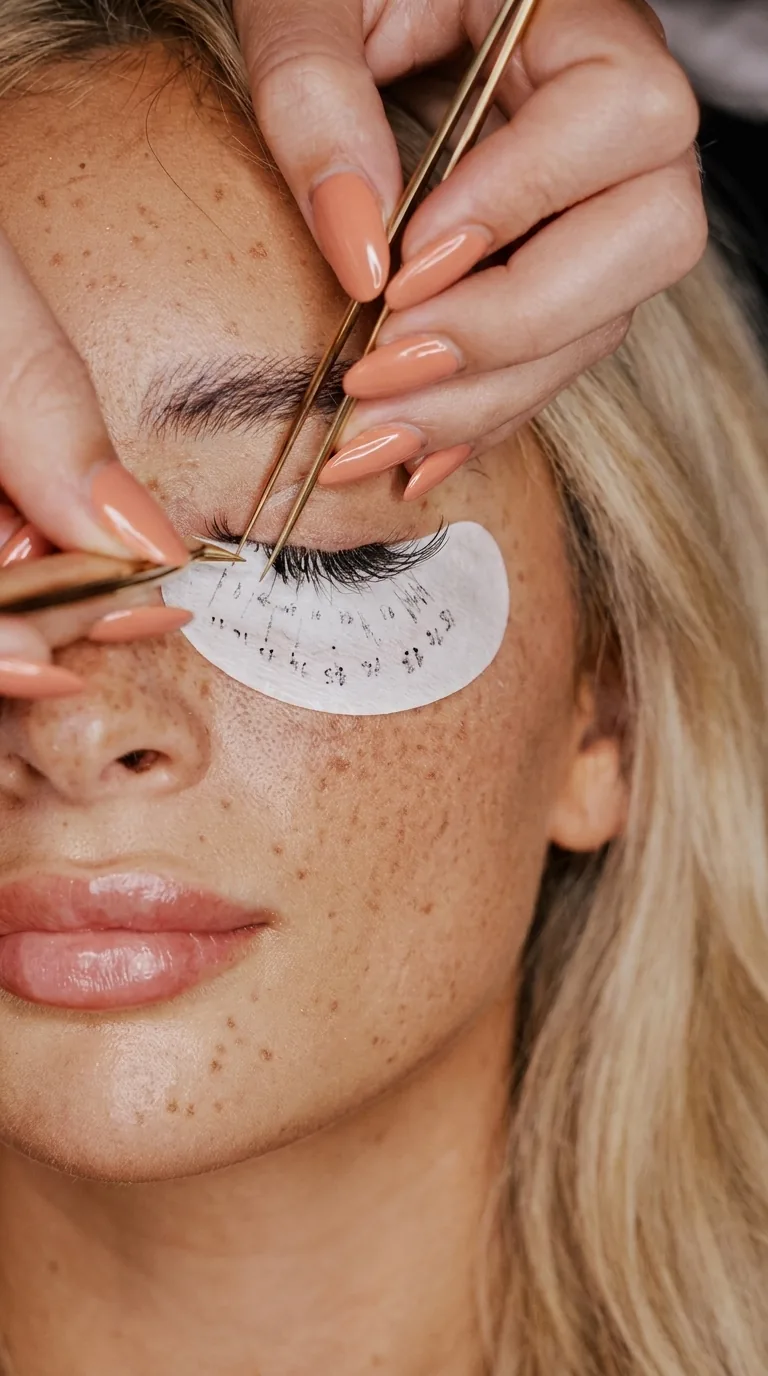
Hooded eyes are the shape that humbles a confident map. Everything that works on an almond eye, a long outer sweep, a strong D curl, a gentle climb from 9 to 13, can vanish the moment the client opens her eyes and the fold drops over the lash line. The set isn't gone. It's just hidden, and from the front all anyone sees is the tips.
So the job with a hood is different. You aren't decorating the lash line, you are getting the lashes out from under a lid that wants to sit on them. Once you think of it that way, every choice in the map gets simpler. If you've never mapped a set before, read how to do lash mapping first and come back. The rest of this guide assumes you know what a zone is.
How a hood hides length
On a hooded eye the skin above the crease folds forward and rests on, or just above, the lash line when the eye is open. That fold covers the base of every lash and a good part of the middle. What's left visible is the last few millimeters of the tip. Add length and you don't add visible lash, you push more of it up into the fold, where it either disappears or catches on the skin and gets pushed flat.
You can see this on any client in about ten seconds. Ask her to close her eyes and look at the set. Then ask her to open them and look straight ahead. The difference between those two views is the hood, and it's why a map that looked balanced on the pad can look short and uneven once she's sat up.
The practical rule I give beginners: on a hooded eye, the visible length is the length that clears the fold, and nothing else counts.
Why the lift matters more than the length
Two lashes, same 11 mm. One is a J curl, nearly straight, so it leaves the lid at a low angle and slides straight up under the hood. The other is a CC, so it turns upward early and its tip sits in front of the fold rather than behind it. On a hooded eye the CC reads longer, even though they're the same lash.
That's the whole trick. Lift is what decides whether a lash shows. Length only decides how much of the tip you see once it does. So on a hood you choose the curl first, then the length, which is the opposite order to most maps. A set in 10 and 11 mm with the right curl will look more open than a set in 13 mm with the wrong one, and it'll be kinder to the natural lash too.
Where the longest lengths go
Hooded eyes come in a few flavors, and the peak of the map moves with them.
Open the eye at the outer third
Most hoods are heaviest at the outer part of the lid, where the fold drops lowest. Placing the longest lengths through zones 4 and 5, the outer third but not the very corner, lifts that part of the eye and makes it look wider and more awake. It's the safest default for a hood.
Don't carry the peak all the way to zone 6, though. The last few lashes at the outer corner are the finest and the most downward facing, and a heavy hood presses on them hardest. Put your longest length there and it drags the corner down, which is the one thing a hooded eye never needs. Step down a millimeter or two for the last zone.
The arch for a doll effect
If the hood is fairly even across the whole lid, a centre peak works beautifully. Longest length over the pupil, easing off on both sides, and the eye reads rounder and more open. This is the doll or open eye map, and on a symmetrical hood I'd pick it over a cat eye nine times out of ten. A cat eye on a droopy hood just follows the droop.
Whichever peak you choose, keep the climb gentle. Go up a millimeter a zone, not two. Sharp steps look like a staircase on any eye, and under a hood they look like gaps.
Curls for hooded eyes
This is the decision that makes or breaks the set, so I'll be specific. Our lash curl chart has every curl drawn out if you need the shapes in front of you.
- C and CC are my first pick for most hoods. They lift early enough to clear a light or medium fold without curling back into it, and they keep the lash looking long because the tip still travels forward. A CC is the one to try when a C looks a touch flat.
- L and M are for the heavy hood. Both have a flat base that bonds along a straight natural lash, then a sharp kick upward. The flat base sits under the fold and the kick happens in front of it, so the tip pops out from under even a low lid. If a client's lashes point straight down, start here.
- D is the one to be careful with. On a mild hood a D looks gorgeous. On a heavy one the tip curls so far back that it tucks itself up under the fold and the set reads shorter than a C in the same length. If you reach for a D, check it with the eye open before you commit the whole row.
- J and B are usually too flat. Save them for a lower lash line.
Mixing curls across the map works well on a hood. A CC through the inner zones with an L or M through the heavier outer zones gives you lift exactly where the fold is lowest, and the two blend if you step between them at a zone boundary rather than mid row.
Keep the inner corner short
Zone 1, the few millimeters nearest the nose, should stay at 7 or 8 mm on almost every hooded map. The inner lashes are short and fine, the inner corner usually has little hood at all, and length there pulls the eye inward and makes it look smaller. Short inner corners also give the longer outer zones something to be long against, which is what creates the open look in the first place.
Natural lash health and weight
Hooded lids touch the lashes all day. Every blink drags the fold across the set, which is why retention on a hooded client can be shorter and why heavy work ages badly on them. A few rules I stick to:
- Keep lengths within about 2 to 3 mm of the natural lash. The lift is doing the work, so you don't need the extra length to get the effect.
- If you're doing volume, use lighter fans, 0.05 or 0.07, rather than fewer heavy ones. A heavy fan under a lid that presses on it will twist.
- Mind the direction. Place every extension so its tip points slightly outward, not straight up, so the lashes fan rather than stack into the fold.
- If the client's lashes are already weak, map lighter and shorter than you'd like and tell her why. A set she can keep for three weeks beats one that looks amazing for four days.
A worked map for hooded eyes
Here is a six zone map I'd hand a beginner for a medium hood with a heavier outer lid. Inner corner on the left, outer corner on the right. Scale the whole thing up or down a millimeter to suit the natural lash, but keep the proportions.
| Zone | Z1 | Z2 | Z3 | Z4 | Z5 | Z6 |
|---|---|---|---|---|---|---|
| Length | 8 | 9 | 10 | 11 | 11 | 10 |
| Curl | CC | CC | CC | L | L | L |
| Why | short, keeps the eye open | easing out | centre lift | the peak starts | peak, heaviest hood | step down, no drag |
For an even hood that suits a doll effect, move the peak inward: 8, 10, 11, 12, 11, 9 in a CC throughout, and step to an L in zones 4 to 6 only if the outer lid sits low. If you want to compare that to other number maps, the lash mapping chart guide has a table of them.
Common mistakes on hooded eyes
- Mapping with the eyes closed only. The map looks perfect on the pad and disappears when she sits up. Always check with the eye open and the client looking straight ahead.
- Chasing length to fix a hidden set. If 11 mm is disappearing, 13 mm won't appear. Change the curl, not the number.
- A long outer corner. It feels like it should open the eye. On a hood it drags the corner down and the whole eye looks tired.
- A D curl on a heavy fold. Lovely on the pad, tucked under the hood by the time she's at the door.
How to check the map on a real photo
The surest way to know a hooded map works is to look at it from the front, open eyed, before you apply anything. Take a straight on photo of the client with her eyes relaxed and open, not wide, and look at where the fold actually sits. Then put the map on that photo. If the longest lengths land where the fold is lowest and the tips still show, you're right. If the peak disappears under the lid, move it or lift the curl and look again.
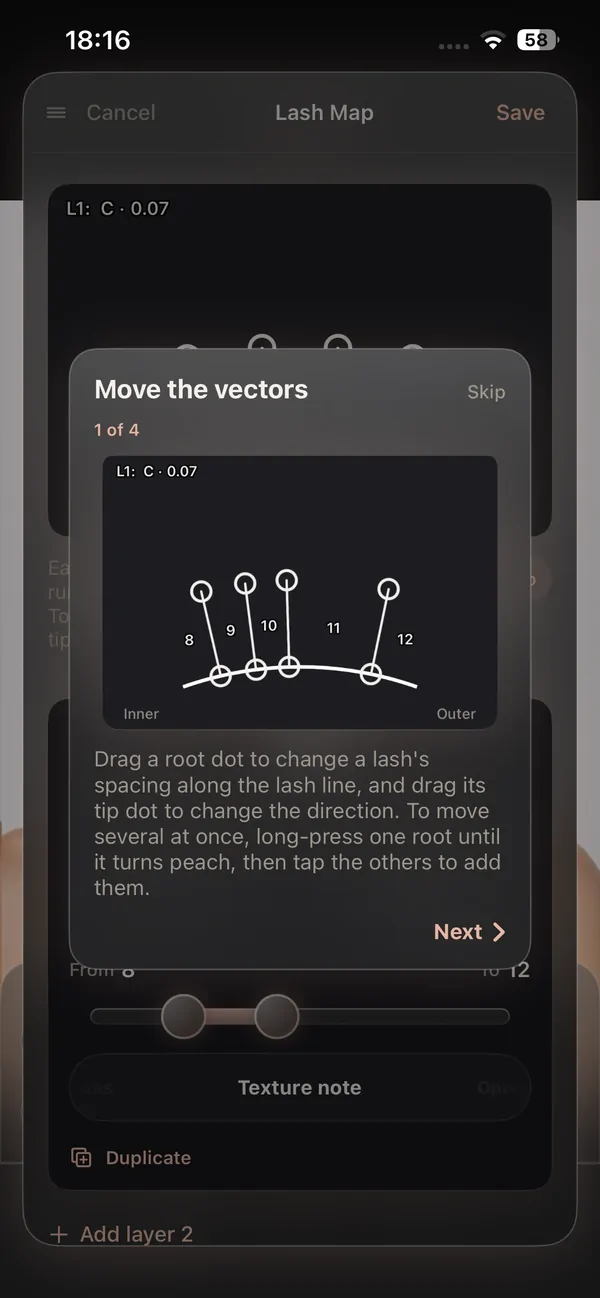
In Lash Create you can do that in a minute. Open her photo, add the lash preview onto both eyes, switch between a C, a CC and an L and watch which one clears the hood, then long press the style you've settled on to reveal the full map with the zones and lengths laid out. The client sees the same picture, so when she says yes to the look she's saying yes to the real one. This eyelash try on is also lovely for clients who've been told hooded eyes "can't take lashes". They can, and seeing it on their own face ends the argument.
For the other eye shapes, round, almond, monolid, downturned and the rest, our guide to the best lash style for your eye shape runs through each one.
On a hooded eye the curl is the map. Choose the lift first, keep the inner corner short, and let a modest length do a lot of work.
See the hooded map on the real lid.
Open a photo of your client, drop the lash preview onto her eyes and switch between a C, a CC and an L to see which one clears the fold. Long press your chosen style and the full map appears across the lash line. Free to try on iPhone and iPad.
Download free on the App Store Scan to install on your iPhone or iPad
Frequently asked questions
What is the best lash map for hooded eyes?
For most hooded eyes, a map that keeps the inner corner short and peaks through the centre or the outer third, with a C or CC curl and an L or M where the fold is heaviest. An open or doll eye map suits an even hood, and an outer third peak suits a hood that drops at the outer lid.
Which lash curl is best for hooded eyes?
C and CC curls suit most hoods because they lift early without curling back into the fold. L and M curls, with their flat base and sharp kick, are the ones for a heavy hood or lashes that point straight down. A D curl can tuck under a heavy fold, so test it with the eye open first.
What lash length is best for hooded eyes?
Shorter than you'd think. Most hooded maps run from about 8 mm at the inner corner to 11 or 12 mm at the peak, because the lift is doing the work and extra length just disappears under the fold. Stay within 2 to 3 mm of the natural lash.
Can hooded eyes have cat eye lashes?
They can, but with care. A cat eye puts the longest length at the outer corner, which on a heavy hood can drag the eye down. Keep the peak at zones 4 and 5 rather than the very corner, use a lifting curl, and check the shape on a photo with the eye open.
How do I map lashes for hooded eyes?
Choose the curl first, a C or CC for a light hood and an L or M for a heavy one. Keep zone 1 short at 7 or 8 mm, climb a millimeter a zone to a peak over the centre or the outer third, then step down for the last zone. Check the map with the eyes open before you apply.
Can I see a hooded eye lash map on my own photo?
Yes. In Lash Create you add the lash preview onto a photo of your own eyes, switch between styles and curls, and long press a style to reveal its full map. You can see whether the lashes clear your lid before anyone picks up tweezers, and it's free to try.
Try a hooded map on your own eyes.
Download Lash Create and preview the set on a real photo, with every style, curl and map built in.